InsightsInternational Money
How Exchange Rates Can Quietly Reduce the Value of a Professional Athlete’s Contract
An athlete’s salary may stay fixed while its real value changes. This guide explains how exchange rates, transfer costs and international commitments can quietly affect an overseas sports contract.
Published 14 July 2026Last reviewed 15 July 20269 minute read

At a glance
- Who this is for
- Professional athletes earning or spending across multiple currencies.
- Best read
- Before signing an overseas contract or moving country.
- Reading time
- 9 minutes
- Key takeaway
- A fixed salary does not always mean a fixed value.
On the evening of 23 June 2016, a footballer at an English club went to bed with everything in order. Same contract. Same club. Same wage due at the end of the month.
By breakfast, the Pound had fallen 6% against the Euro. It was the biggest one-day fall in a major currency since 1971.
Nothing about his job had changed. Nobody from the club called. His payslip at the end of the month looked exactly like the one before.
But his mortgage was in Spain. His parents were supported in Euros. Measured in the currency his life actually ran in, he had just taken a pay cut that nobody negotiated, nobody announced and nobody mentioned.
That was the dramatic version. It made the news.
The quiet version never does. It happens to internationally mobile athletes every month. A percentage on the exchange rate here. A margin on a transfer there. A large sum moved on the wrong day. Small numbers, repeated for years, applied to the biggest income of your life.
This article explains how it happens, what it looks like in your sport, and what to ask before the next contract is signed.
Why does this hit athletes harder than most people?
Most people earn, spend and save in one currency for their whole working life. The exchange rate is holiday money.
Your life is set up differently.
Your contract is in one country. Your family might be in another. Maybe there’s a house somewhere else, parents you support, investments abroad. Salary, image rights and endorsements might each arrive in a different currency. And every couple of years, the whole thing moves.
Every one of those is a currency decision, whether anyone treats it that way or not.
You also have less time. Most people earn for forty years. You have ten, maybe fifteen. A little lost every year hurts far more in a short career than a long one.
And none of it shows on your payslip. That’s why nobody around you is watching it.
How can a fixed salary lose value?
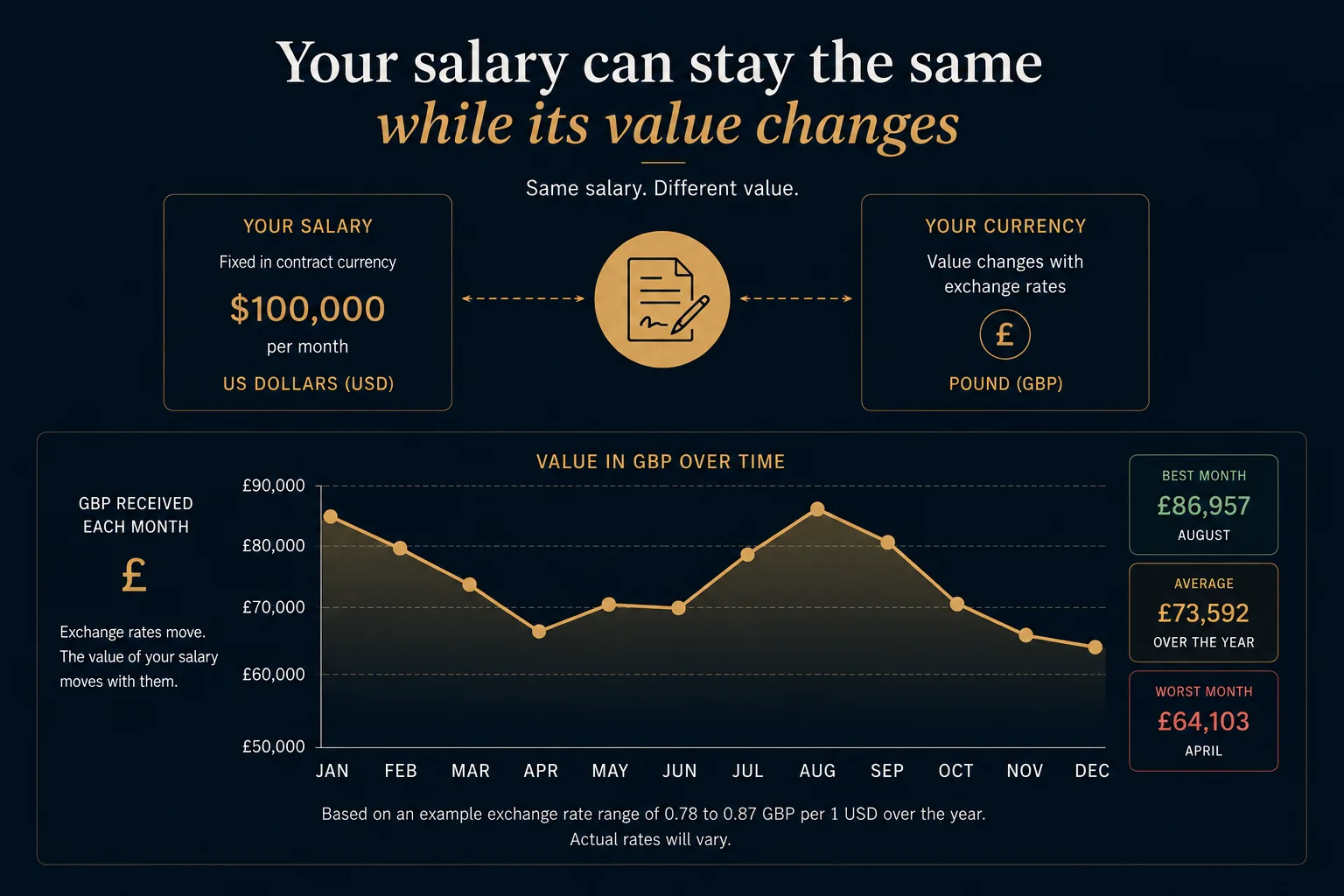
Say you are playing overseas and earning $100,000 a month. Your mortgage, family commitments and long-term plans are all in the UK.
Your salary remains fixed at $100,000. What that salary is worth in Pounds changes every time the USD/GBP exchange rate moves.
That’s the whole issue. You earn in US Dollars. The rest of your life runs in Pounds Sterling. The house. The family. The savings.
The moves are bigger than most people think. A major currency can swing 10% to 15% in a year. On a seven-figure contract, that’s six figures gained or lost. Before tax, before fees, and before anyone has made a mistake.
You’ll never see it on a payslip. It only shows up at the other end, where the mortgage is.
Where does the money actually go?
Three places.
The rate moves
Between the day a deal is agreed and the day the money is paid, the exchange rate can change.
In January 2025, a club agreed a €25 million transfer.
By April, the same transfer cost £849,495 more.
Nothing about the deal had changed.
The player had not changed.
The agreed fee had not changed.
Only the exchange rate had moved.
One club. One deal. Three months.
A five-year contract has sixty paydays.
The cost of moving it
Every transfer has two costs. There’s the fee you can see. Small, sometimes zero. Then there’s the margin you can’t: the gap between the rate on your phone and the rate you actually get.
Typical margins are 2% to 3%. On some salary transfers, banks have taken as much as 4.5%. Nobody sends you a bill. The money just never arrives.
The part nobody mentions
Almost everyone paid from your contract is paid on the gross amount, in the contract currency. Your agent, your manager, some advisers. If the rate takes 10% off what your money is worth at home, their fees don’t shrink. Yours does.
That’s not a dig at anyone. It’s just how the incentives are set up, and worth knowing when you’re working out whose problem this is.
What does this look like in my sport?
Football
You’re paid in the league’s currency. Your life often runs somewhere else.
Turkey shows how seriously people inside the industry take this. Foreign players in the Süper Lig are generally paid in Euros, while local players are paid in Lira.
In 2025, the Lira fell by around 38% against the Euro.
The agents who insisted on Euros understood exactly why the payment currency mattered.
Basketball
Players moving between European and Asian leagues are routinely told: get the deal in US Dollars, paid to an account at home. A €220,000 offer in Turkey looks strong on paper. Without that clause, it can shrink between signing and season’s end.
Tennis
No club, no payroll. Prize money lands tournament by tournament, in local currency, after local tax. Wimbledon pays Pounds. New York pays Dollars. A single season can move prize money through your account in several different currencies. Nobody is managing that but you.
Rugby
The big Japan deals are earned in Yen. Around ¥76 million, roughly US$700,000, plus housing and extras. The lives behind them usually run in Pounds, Euros or New Zealand Dollars. Comparing a French offer with an English one is an exchange-rate question before it’s a rugby one.
Golf
The DP World Tour money list runs in Euros, but around half the events pay in Pounds or Dollars, converted at that week’s rate. Two players, same finishes, different weeks. Different money.
I’m moving to Dubai. Doesn’t a stable currency protect me?
It is one of the questions we hear most often.
The UAE Dirham is fixed to the US Dollar.
That means the Dirham itself does not move much against the Dollar.
But that does not mean your salary is protected if your life is based in the UK or Europe.
If you are paid in Dirhams but later move the money into Pounds or Euros, the value you receive still depends on how the US Dollar is performing against those currencies.
A simple way to think about it is this:
A salary paid in Dirhams gives you exposure to the US Dollar.
If the Dollar weakens against the Pound, the same Dirham salary is worth less when moved back to the UK.
If the Dollar strengthens, it is worth more.
The salary shown on your contract has not changed.
What it can buy in your home country has.
We work with specialists who deal specifically with foreign exchange inside the professional sports industry. One of the problems they see most often is the difference between the headline contract value and the amount that eventually arrives in the athlete’s home currency.
Currency is also only one part of an international move. Banking, tax residency, property, family and future plans may all change at the same time. What happens to my money when I move country? covers the rest.
What should I ask before signing?
Most currency problems are created on signing day and discovered a year later.
Some of this is negotiable. Which currency the salary is in. Which one the signing bonus and image rights are paid in. Whether there’s a review if rates move sharply. These are contract terms like any other. The time to raise them is before you sign, while you still have leverage.
Comparing offers? A €3 million offer, a £2.2 million offer and a Gulf package can’t be compared as raw numbers. Put them side by side in the currency your life runs in, after the exchange and after the costs. Tax matters too; that’s an article of its own.
Three simple tools exist. A multi-currency account lets you hold different currencies and choose when to convert. A forward contract locks today’s rate for a payment you know is coming, like a signing bonus or a house purchase. Rate alerts tell you when the rate hits a level you’ve chosen, so timing becomes a decision instead of luck.
Knowing these exist is education. Choosing between them is a job for a specialist.
What mistakes should I avoid?
“It only matters when I transfer money.”
It changes what your whole contract is worth, every day.
“My bank handles it.”
Your bank moves the money. That does not mean anyone has reviewed the exchange rate or the cost.
“The bigger number is the better contract.”
Not when the offers are in different currencies.
“It’s pegged, so I’m safe.”
Pegged to the US Dollar. Are you spending or saving in Dollars?
“It’s only 2% or 3%.”
On a seven-figure contract, repeated over several years, that can become a significant amount.
“I’ll wait for a better rate.”
That turns a planned transfer into a currency gamble.
“Someone on my team is watching this.”
Never assume. Ask who is responsible and what they are monitoring.
Whose job is this?
Go around the table.
Your agent’s job is the deal, and the fee is settled on the gross the moment you sign. The club pays what it owes, in its own currency, and stops there. The bank does what it’s told. Your family sees the consequences but was never given the controls.
Everyone is doing their job. The exchange rate just isn’t in anyone’s job description.
That’s the real problem. Not that currencies move. Everyone knows that. It’s that usually nobody around you can see the contract currency, the life currencies and the future plans in one picture.
The fix is simple to describe: someone who saw the currency question coming before you signed. Not after the first disappointing transfer.

What can I do this week?
- Before signing. Know the currency of the salary, bonus and image rights. Ask whether a currency clause is possible. Compare offers in your home currency, not theirs.
- When you arrive. Find out where your salary lands and what the bank takes each time. Decide on purpose whether a multi-currency account fits.
- From then on. Map what you pay for, by currency. If buying property is part of the plan, know which currency the purchase will happen in. Make convert-or-hold a decision, not a habit. Name the one person who owns this.
- Walk away from. Costs nobody can show you. “We’ll sort it later.” Advice from anyone paid on the gross.
Questions we hear
What currency are Premier League players paid in?
Pounds. Nearly every league works the same way: you’re paid in the league’s currency, not yours.
Can I choose the currency I’m paid in?
Sometimes. Bonuses and image rights can occasionally be set in a different currency, and some leagues routinely pay overseas players in Euros or Dollars. It’s a negotiation point, so raise it before signing.
Do I have currency risk in the UAE or Saudi Arabia?
Yes. Dollar risk. Both currencies are pegged to the US Dollar, so against the Pound or the Euro your money moves with the Dollar.
Should I convert my salary every month or hold it?
It depends on your commitments and your plans. What matters is that it’s a deliberate decision made with someone who sees your whole picture, not a default that happens to you.
What is a forward contract?
It locks today’s exchange rate for a payment on a future date, like a signing bonus or a house purchase, so the market can’t move against you while you wait.
How much do banks charge on international transfers?
The visible fee is small. The real cost is the exchange-rate margin. Usually 2% to 3%, and on some salary transfers as much as 4.5%.
The Athlete Office View
One thread of a wider picture.
Currency is real money, and on an international contract it deserves real attention. But it’s one thread.
Where you’re paid shapes where you pay tax. That shapes what buying a house means. The house shapes where your family settles. Schools, friends, what comes after sport. And the next move reshuffles all of it.
These decisions rarely go wrong on their own. They go wrong in the gaps between them. Between the agent and the bank. Between this country and the next. Between the person who did the contract and the person who handles everything after it.
The athletes who get this right didn’t learn foreign exchange. They built a team where someone sees the whole picture, before signing rather than after.
If you’re weighing up a move, or looking back at one and wondering what it’s quietly costing, that’s a conversation we have calmly, and in private.
The Athlete Office Brief
- Situation
- You’re earning in one currency but your life is spread across several others.
- Risk
- Exchange rates can quietly reduce the real value of your contract over time.
- Opportunity
- Planning your currency strategy before signing gives you more control than reacting afterwards.
- The next question
- Is your wider financial life set up for the country you’re moving to?
James founded The Athlete Office to help athletes coordinate the financial decisions that happen throughout their careers.

Continue Reading
Keep thinking clearly.
We work alongside trusted specialists to help athletes, families and the people around them understand how major decisions connect.
All insightsThis content is for general information only and should not be treated as personal financial, investment, tax, legal or pension advice. Decisions should be made only after speaking with a suitably qualified professional who understands your personal circumstances.
A wider decision than currency alone
Moving clubs or countries can affect your contract, banking, tax position, property plans and family at the same time. The Athlete Office helps athletes understand how those decisions connect and which specialists may need to be involved.
Start a private conversationThe Athlete Office builds the right team around you, at every stage of your career.